There isn’t one UHF setup that is automatically better than another.
A handheld UHF and a fixed UHF unit both serve different purposes, and the right choice depends on what you actually need the radio for.
If you’re looking at a fixed UHF unit, there are even more things to consider. The vehicle itself, where you travel, the terrain, antenna type, antenna gain and mounting position can all affect what setup makes the most sense.
That’s why choosing a UHF should start with one simple question:
What do you need it to do?
When Does a Handheld UHF Make Sense?
One of the biggest advantages of a handheld UHF is portability.
It isn’t tied to a vehicle, which makes it useful across a wide range of activities.
A handheld UHF can be a practical option for:
- Hiking and outdoor adventures
- Camping
- Job sites
- Helping guide vehicles while reversing
- Communication between workers on site
- Helping guide crane operators
- Spotting a 4WD through a difficult section of track
- Staying in contact with someone during a recovery
You can simply take the radio with you wherever you need it.
For someone who mainly needs portable communication away from a vehicle, a handheld may be all that is required.
When Does a Fixed UHF Unit Make Sense?
A fixed UHF unit is permanently fitted to the vehicle and connected to an externally mounted antenna.
This makes it particularly useful for drivers who regularly want to communicate while travelling.
That could include:
- Convoy driving
- Touring
- Regional travel
- Trips with other 4WDs
- Regular off road driving
- Travelling in areas where mobile reception may be limited
Because the system is installed in the vehicle, it is always there and ready to use rather than needing to be charged, carried and set up each time.
But the radio itself is only one part of a fixed UHF setup.
Why the Antenna Matters
The antenna can have a significant impact on how a fixed UHF setup performs.
UHF communication relies heavily on line of sight, so the surrounding terrain, antenna height and antenna gain all need to be considered.
One of the easiest ways to understand antenna gain is to look at the shape of the signal.
As the chart below shows, a lower-gain antenna has a broader signal pattern, which can make it better suited to hilly or mountainous terrain where vehicles may be at different elevations.
A medium-gain antenna provides a balance between the two and can suit drivers who regularly travel through a mix of flatter and more varied terrain.
A higher-gain antenna has a flatter, more concentrated signal pattern, making it better suited to open, flatter country where communication is generally happening closer to the same elevation.
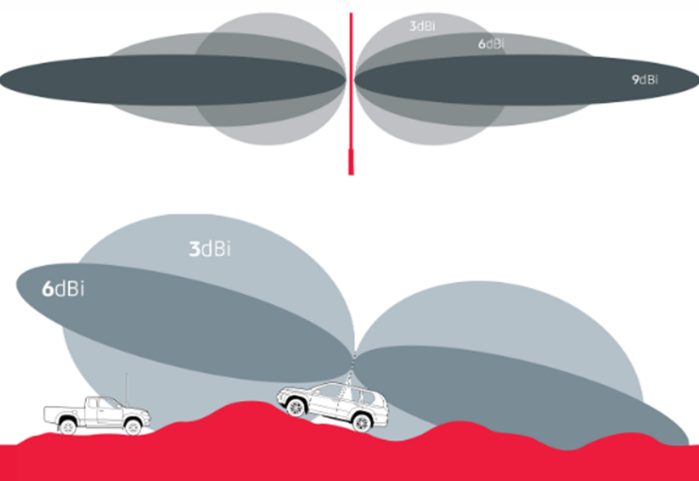
This is why the biggest antenna or the highest dBi number isn’t automatically the best option.
The right antenna depends on where you travel and what you need your UHF to do.
Where Should the Antenna Be Mounted?
There isn’t one mounting position that suits every vehicle either.
Depending on the vehicle and the accessories already fitted, there may be several possible mounting options.
The position needs to take into account things such as:
- The vehicle
- Antenna type
- Antenna height
- Clearance
- Existing accessories
- Practicality
- Where the vehicle is regularly driven
Different vehicles can require very different solutions.
That is why antenna placement should be considered as part of the complete UHF setup rather than treated as an afterthought.
Can You Just Use a Handheld Inside the Vehicle?
You can use a handheld UHF inside a vehicle, but it may not provide the same performance or range as a properly selected fixed UHF unit with an external antenna.
The vehicle itself can affect the handheld radio’s signal, while a fixed UHF unit has the advantage of an antenna mounted externally.
That doesn’t make the handheld worse.
It simply means the two types of radio are designed to do different things.
If portability is what matters most, a handheld can be the better tool for the job.
If you regularly need communication while driving over longer distances, a fixed UHF unit may make more sense.
Sometimes Having Both Is the Most Useful Setup
For some people, the answer isn’t handheld or fixed.
It’s both.
A fixed UHF unit can handle regular communication while travelling, while a small handheld gives you something you can take with you when you leave the vehicle.
For example, you might use the fixed UHF while travelling in convoy, then hand a portable radio to someone who needs to:
- Help guide you while reversing
- Spot the vehicle through a difficult track
- Assist during a recovery
- Walk away from the vehicle
- Communicate around camp
- Move between vehicles
The handheld can also be used completely independently for hiking, work sites, camping and other situations where a vehicle isn’t involved at all.
That versatility is one of the main reasons a small handheld can still be useful even when a vehicle already has a fixed UHF unit.
There Are Too Many Variables for One UHF Setup to Suit Everyone
Choosing a UHF can become more complicated than simply picking a radio off the shelf.
The right setup can depend on:
- What you need the UHF for
- Whether you need portability
- The vehicle
- Where you travel
- The terrain
- How frequently you use it
- Antenna type and gain
- Antenna mounting position
- The other accessories already fitted to the vehicle
Someone who needs a radio for hiking and job sites has very different requirements to someone building a touring 4WD for long distance travel.
Even two people with the same vehicle may need different UHF setups depending on where they travel and how they use it.
There isn’t one option that is simply “better”.
It comes down to choosing the right equipment for the job.
Finding the Right UHF Setup
If you’re choosing a UHF, start by thinking about when and where you actually expect to use it.
Do you need something you can carry with you?
Do you mainly need communication while driving?
Are you travelling in convoy?
What type of terrain do you normally drive through?
Would having both a fixed UHF unit and a smaller handheld give you more flexibility?
For a fixed UHF setup, the antenna and where it can be mounted also need to be considered alongside the radio itself.
At ARB Rockingham, we can look at your vehicle, how you use it and what you need your UHF to do before recommending a setup.
Whether that ends up being a handheld, a fixed UHF and antenna package, or a combination of both, the aim is to find something that suits your actual needs rather than using the same setup for every customer.
Visit ARB Rockingham at 57 Dixon Road, Rockingham or book an appointment with the team to discuss the right UHF setup for you.